Managing employee leave in Zambia is not optional — and it is not simple. The Employment Code Act No. 3 of 2019 (ECA 2019) defines eight distinct categories of leave, each with its own entitlement, eligibility conditions, and employer obligations. Getting any one of them wrong exposes your business to labour disputes and potential Ministry of Labour scrutiny.
I have spent the past several months working through these provisions directly — first to understand what the Act actually requires, and then to verify how ZamPay implements each one. This guide is the result of that work: every statutory leave type, in plain English, with the section references so you can check the source yourself.
Zambian Statutory Leave at a Glance
The table below summarises all eight leave types under ECA 2019. All are seeded automatically for every active company on ZamPay.
| Leave Type | Section | Entitlement | Who It Covers | ZamPay |
|---|---|---|---|---|
| Annual Leave | s.36 | 24 days/year, full pay | All employees* | Compliant |
| Sick Leave | s.38 | 26 days full pay + half-pay continuation | All employees | Compliant |
| Compassionate Leave | s.39 | 12 days/year, full pay | All employees | Compliant |
| Family Resp. — Sick Family | s.40(1) | 7 days/year, full pay | 6+ months service | Compliant |
| Family Resp. — Care & Education | s.40(2) | 3 days/year, full pay | All employees | Compliant |
| Maternity Leave | s.41(1) | 98 days | Female employees | Compliant |
| Miscarriage / Stillbirth | s.41(6) | 42 days, full pay | Female employees | Compliant |
| Paternity Leave | s.46 | 5 continuous working days | Male employees | Compliant |
| Mother's Day Leave | s.47 | 1 day/month (12/year) | Female employees | Compliant |
* Temporary and casual employees are excluded from annual leave under s.36.
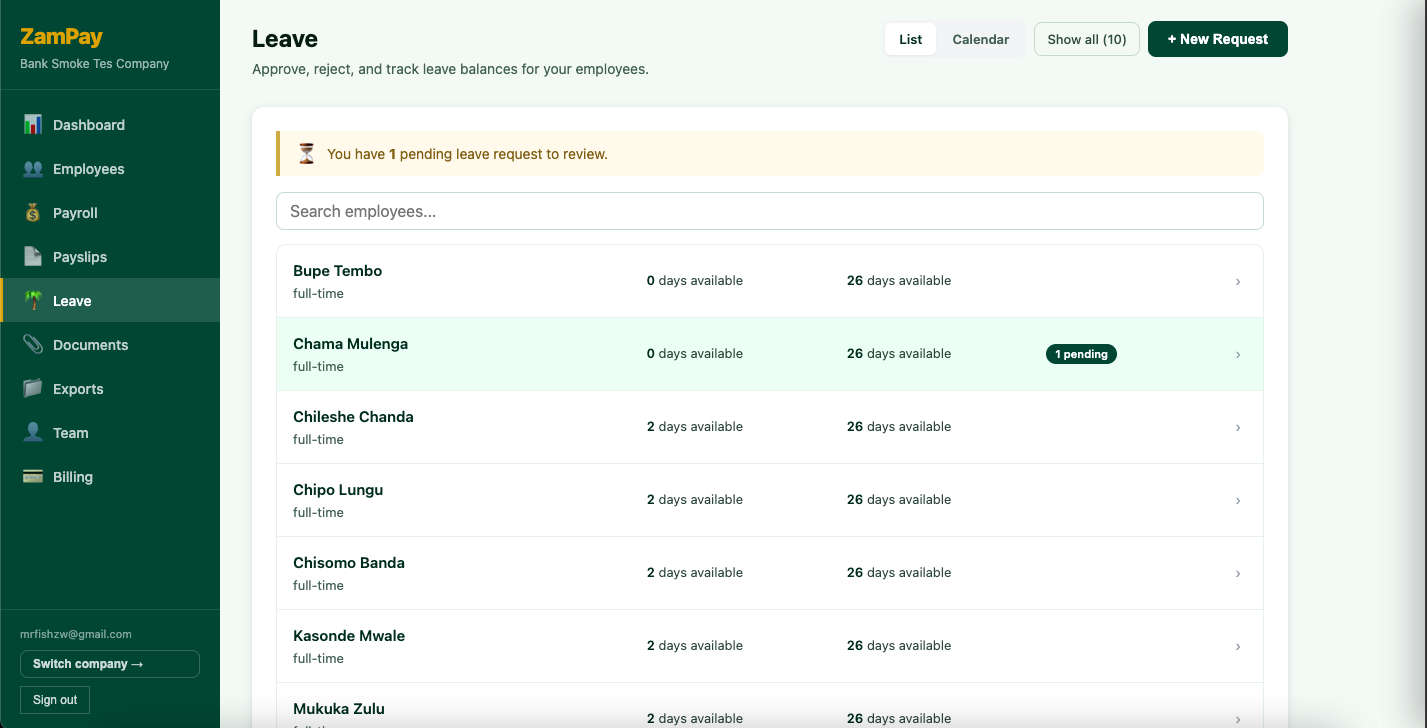 ZamPay Leave — employee list view with live balances.
Annual Leave (Section 36)
What the Act says
An employee — other than a temporary or casual employee — who remains in continuous employment with the same employer for twelve consecutive months is entitled to annual leave on full pay at a rate of at least two days per month. That is 24 days per year.
Key points from s.36:
- Annual leave is separate from public holidays and weekly rest periods (s.36(2)). They cannot be substituted for each other.
- At the beginning of each year, employers must prepare an annual leave plan in consultation with employees, specifying when leave will be taken (s.36(3)). This is not optional.
- If an employer does not grant an employee their full leave entitlement within a 12-month period, the employer must pay wages for the unused leave at the end of that period (s.36(4)).
- With the employee's agreement, an employer may pay wages in lieu of annual leave (s.36(5)).
How ZamPay handles it
ZamPay implements 24 days per year with monthly accrual from the employee's start date. The entitlement is applied to all employee types — more generous than the statutory minimum for businesses that choose to extend it to casual or temporary staff.
The annual leave planning requirement (s.36(3)) is an HR process obligation, not a system enforcement item. Consult your employees, set the leave plan at the start of each year, and document it.
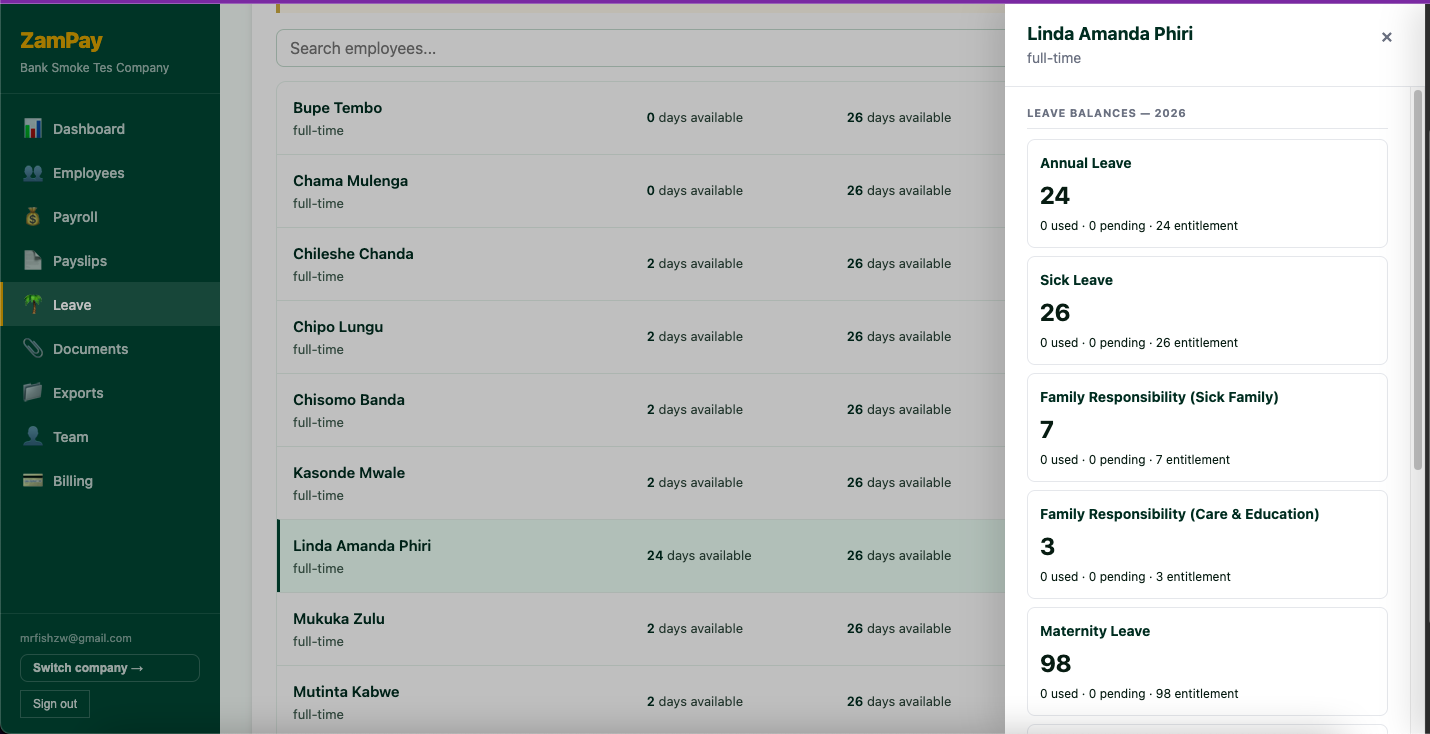
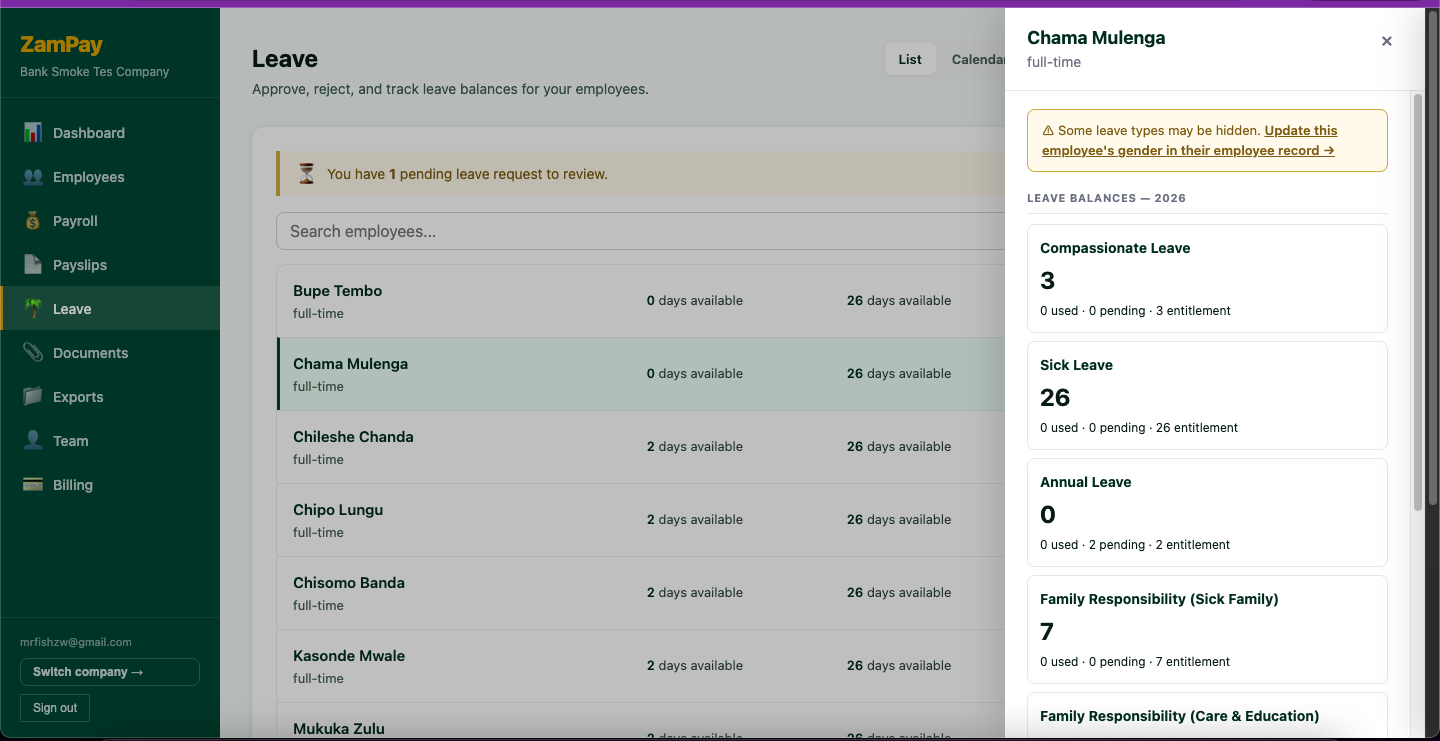 Leave balances by type — visible per employee in ZamPay.
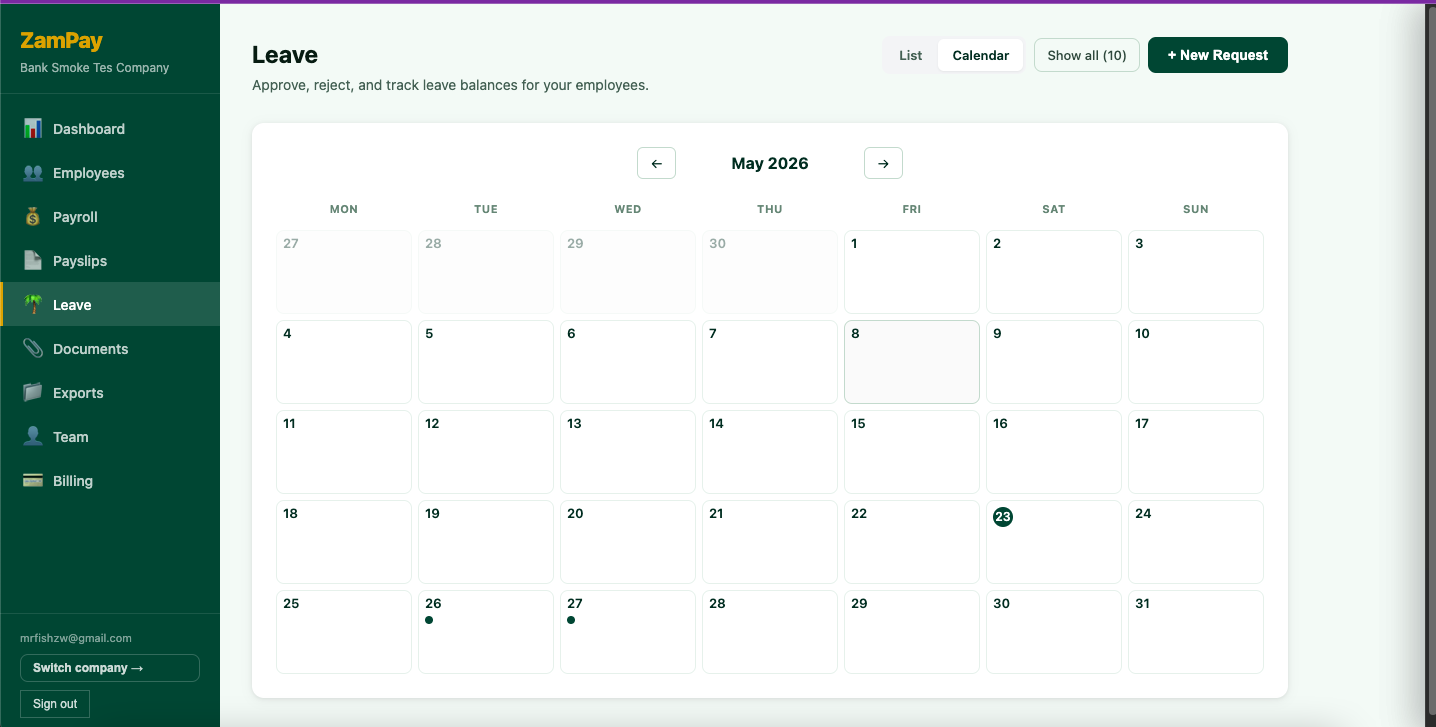 ZamPay's leave calendar — supports the annual leave planning requirement under s.36(3) ECA 2019.
Sick Leave (Section 38)
What the Act says
ECA 2019 distinguishes between two contract types:
Short-term contract (s.38(2)(a)): 26 working days on full pay, followed by 26 working days on half pay.
Long-term contract (s.38(2)(b)): 3 months on full pay, followed by 3 months on half pay.
A medical certificate from a registered health practitioner is required in both cases (s.38(1)).
Three further provisions HR managers must know:
- After 6 months of illness, an employer may — on the recommendation of a medical doctor — discharge an employee on medical grounds (s.38(5)).
- An employee discharged on medical grounds is entitled, in addition to other accrued benefits, to a lump sum of not less than three months' basic pay for each completed year of service (s.38(6)).
- An employer shall not terminate a contract while sick leave provisions apply, unless agreed by both parties (s.38(7)).
- Sick leave under ECA 2019 does not apply to occupational accidents or diseases covered by the Workers Compensation Act (s.38(3)).
How ZamPay handles it
ZamPay implements the full sick leave entitlement under s.38 — 26 days of full-pay sick leave, with half-pay continuation for days 27 and beyond, for both short-term and long-term contract types. Ensure medical certificates are collected and filed against each employee record throughout.
Compassionate Leave (Section 39)
What the Act says
Employees are entitled to at least 12 days of compassionate leave on full pay per calendar year, on two grounds:
(a) the death of a spouse, parent, child or dependant; or
(b) a justifiable compassionate ground.
The phrase "justifiable compassionate ground" is deliberately broad — it gives employers some discretion, but it also gives employees grounds to request leave beyond bereavement.
How ZamPay handles it
ZamPay implements 12 days per calendar year for all employees, fully in line with s.39. No manual verification required for the standard entitlement.
Family Responsibility Leave (Section 40)
ECA 2019 creates two distinct family responsibility entitlements. Both are non-cumulative and neither is deductible from annual leave (s.40(3)).
Sick Family Member Leave (s.40(1))
Employees who have completed at least 6 months of continuous service are entitled to up to 7 paid days per calendar year to nurse a sick spouse, child or dependant. The employer may require a medical certificate confirming that the family member is sick and requires special attention.
Care and Education Leave (s.40(2))
All employees are entitled to 3 paid days per year for responsibilities relating to the care, health or education of a child, spouse or dependant. No service length requirement. No medical certificate required.
How ZamPay handles it
ZamPay implements both entitlements separately — 7 days for s.40(1) and 3 days for s.40(2). Neither bucket is deductible from annual leave, as required by s.40(3).
The 6-month service eligibility condition for s.40(1) is not yet automatically enforced. Verify service length before approving this leave type.
Maternity Leave (Section 41)
What the Act says
Female employees are entitled to 14 weeks (98 days) of maternity leave. For multiple births, this is extended by a further 4 weeks (s.41(2)). A medical certificate is required (s.41(1)).
Leave may be taken immediately before the expected date of delivery, or after — but at least 6 weeks must be taken immediately after delivery.
Full pay applies where the employee has been in continuous employment with the same employer for at least 24 months preceding the start of leave, provided maternity benefits are not paid under another written law (s.41(3)).
Additional employer obligations most HR managers miss:
- An employee who gives birth prematurely is entitled to an extension of maternity leave on a medical doctor's recommendation (s.41(5)).
- On return from maternity leave, the employee is entitled to return to the same job she held before leave — or, if not reasonably practicable, to a suitable alternative on terms no less favourable (s.41(7)).
- A female employee shall not forfeit her annual leave entitlement because she took maternity leave (s.41(10)). This is explicit in the Act.
- An employer shall not terminate an employee's contract or impose any disadvantage as a result of pregnancy or maternity leave (s.43).
- A female employee shall not resume work within 6 weeks of delivery unless a medical doctor certifies she is fit to do so (s.42). This obligation sits with the employer.
Miscarriage and Stillbirth Leave (s.41(6))
A female employee who has been with the same employer for at least 12 months and suffers a miscarriage during the third trimester of pregnancy, or bears a stillborn child, is entitled to 6 weeks (42 days) of leave on full pay immediately following the event. Certification by a medical officer is required.
How ZamPay handles it
ZamPay implements 98 days of maternity leave for female employees, and 42 days for miscarriage or stillbirth. The 24-month full-pay threshold and 12-month service requirement are not yet automatically enforced — verify service length and pay status manually before approving.
The return-to-work restriction (s.42) and the annual leave protection (s.41(10)) are HR process obligations that sit outside the leave balance system. They need to be part of your maternity leave management workflow regardless of what your payroll software does.
 Maternity Leave: 98 days — seeded automatically for every female employee in ZamPay.
Paternity Leave (Section 46)
What the Act says
Male employees are entitled to at least 5 continuous working days of paternity leave, subject to three conditions:
(a) the employee is the father of the child;
(b) the employee has submitted a birth record of the child to the employer; and
(c) the leave is taken within 7 days of the birth.
A further threshold applies: the employee must have completed at least 12 months of continuous employment with the same employer before the leave begins.
How ZamPay handles it
ZamPay implements 5 days of paternity leave for male employees. The 12-month service requirement, birth record submission, and 7-day window are not yet automatically enforced. Verify all three conditions manually before approving.
Mother's Day Leave (Section 47)
What the Act says
Section 47 is brief and unambiguous: a female employee is entitled to one day's absence from work each month without having to produce a medical certificate or give a reason to the employer. The employer cannot refuse this absence or question the reason for it. It amounts to 12 days per year.
How ZamPay handles it
ZamPay implements 12 days per year for all female employees, with Mother's Day Leave available as a selectable leave type when submitting a new request. The monthly drip enforcement — limiting the entitlement to 1 day per calendar month — is a planned Phase 3 enhancement. Until then, the one-per-month restriction is a manual check.
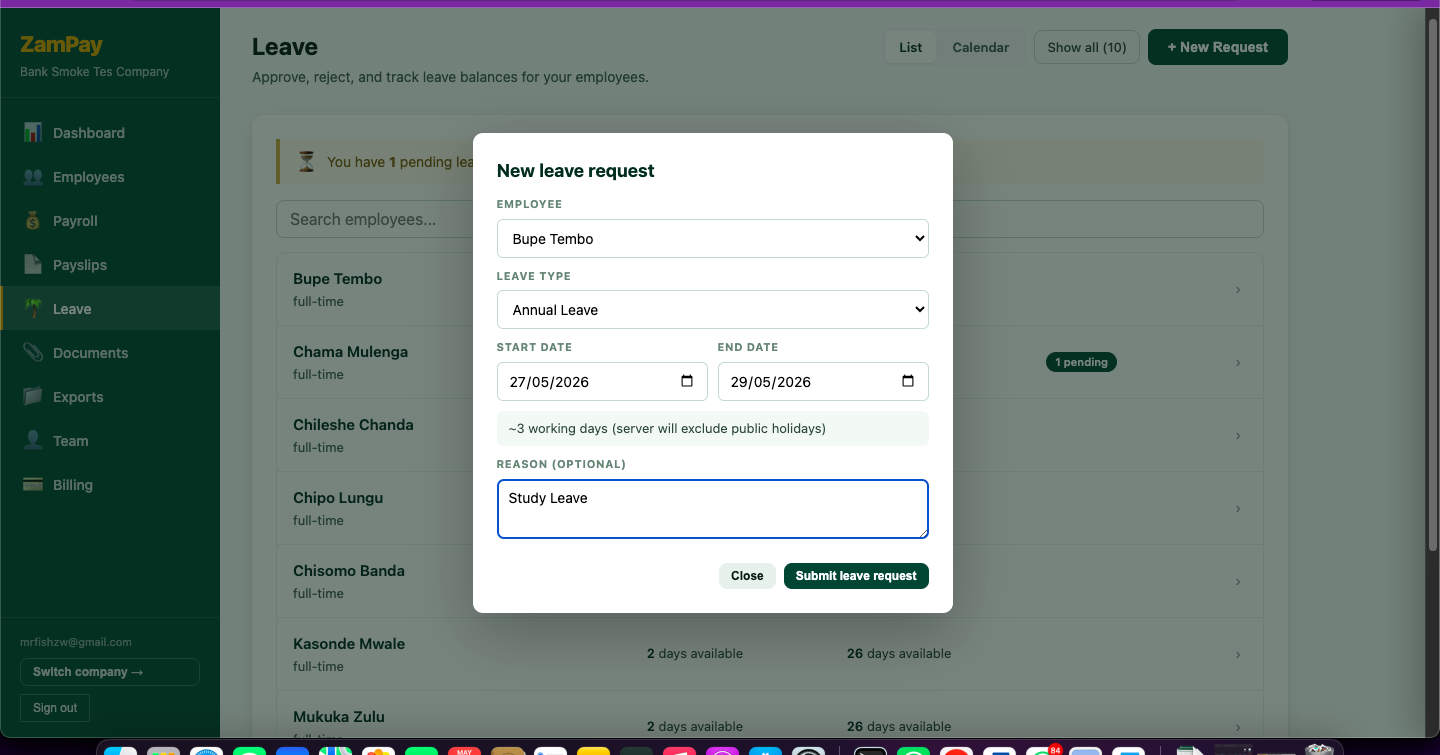 Mother's Day Leave — selectable in ZamPay with no reason required, as per s.47 ECA 2019.
What Is Not a Leave Balance in ZamPay
Two entitlements under ECA 2019 are intentionally not implemented as leave buckets:
Nursing Breaks (s.45): Female employees who are nursing an unweaned child are entitled each working day to either two breaks of 30 minutes each, or one break of one hour — for 6 months from the date of delivery. This is a working-hours entitlement, not a leave type.
Forced Leave (s.48): Where an employer sends an employee on forced leave, the employer must pay the employee their basic pay during that period. This is an employer-initiated administrative action, not employee-requested leave.
What HR Managers Need to Verify Manually
Until Phase 3 automated enforcement is live in ZamPay, the following conditions require manual verification before approving the relevant leave type:
Annual leave: Confirm 12 months continuous service before approving the first annual leave request for any employee applying the statutory minimum. Prepare an annual leave plan in consultation with employees at the start of each year (s.36(3)).
Family Responsibility s.40(1): Confirm 6 months of service before approving.
Maternity leave: Confirm 24-month service threshold for full pay. Confirm the employee is not returning to work within 6 weeks of delivery without medical clearance (s.42). Confirm annual leave entitlement is preserved on return (s.41(10)).
Miscarriage or stillbirth leave: Confirm 12-month service, third trimester condition, and certification by a medical officer.
Paternity leave: Confirm 12-month service, birth record received, and that leave is taken within 7 days of birth.
For specific leave compliance questions, ask Leah, ZamPay's AI compliance advisor.
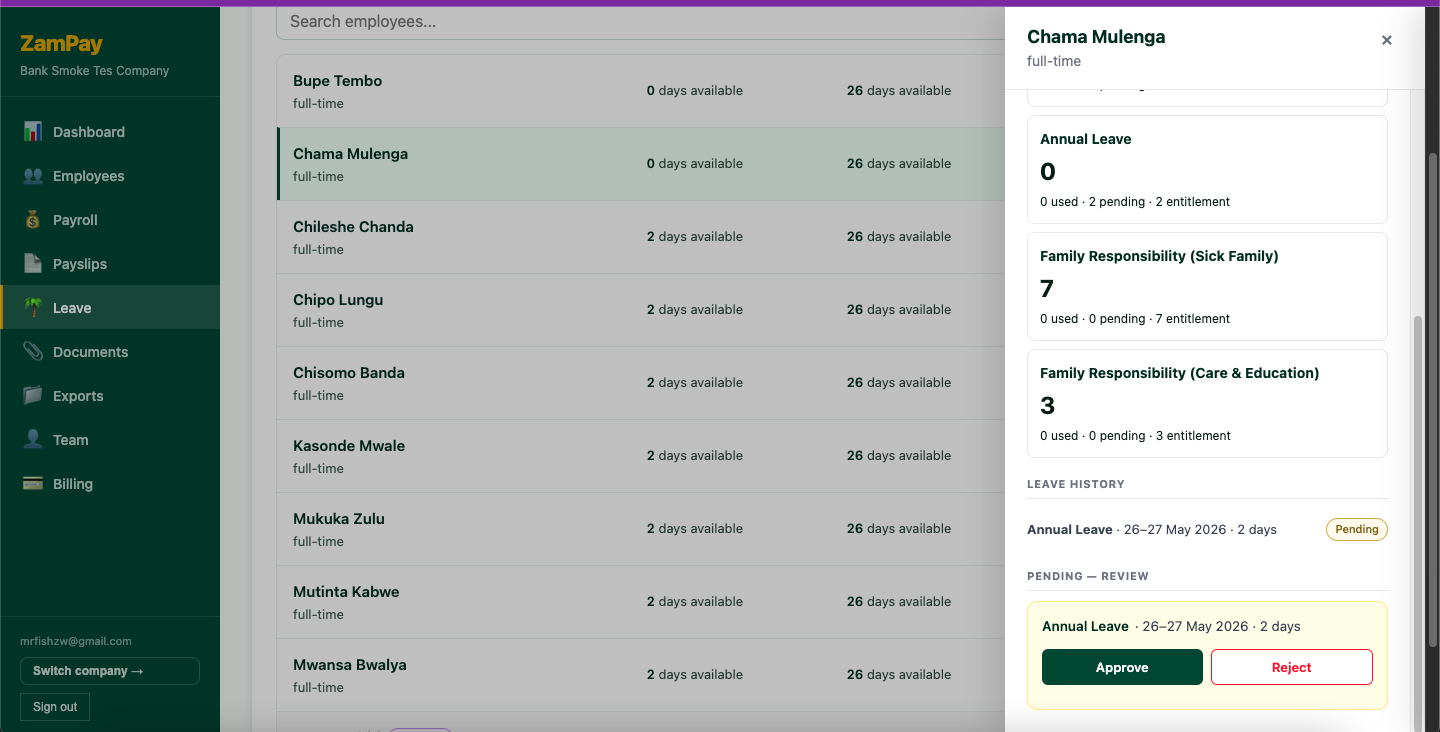 Pending leave request awaiting HR approval in ZamPay.
Where to Start
ZamPay seeds all eight leave types automatically for every active company. Nothing to configure — your employees' leave entitlements are live from the moment your company is set up.
To view your current leave setup:
- Log in at zampay.biz
- Go to the Employees tab
- Select any employee and open their Leave record
All active leave types, current balances, and approval history are visible from that screen.
Not on ZamPay yet? Run a free Payroll Health Check to see how your current leave records compare to the ECA 2019 minimums — or sign up free for up to 5 employees.
Or WhatsApp us at +260 573918484 with any leave compliance questions. We read every message.

Esther Sakala is HR Manager at Unistudy Zambia Limited and ZamPay's first paying customer. She oversees HR compliance for the Unistudy group and has guided ZamPay's implementation of the Employment Code Act from the ground up — including verifying leave entitlements against the primary legislation before they were built into the platform.
— Esther Sakala
HR Manager, Unistudy Zambia Limited
Source: Employment Code Act No. 3 of 2019, read from primary text. Effective 2026.